



Everyone wants to be early to the next big thing.
The instinct, though, is to wait for proof. For validation. For consensus.
“Show me it works first, then I’ll invest time.”
“I’ll wait until the best practices emerge, then I’ll learn.”
“I’ll let others figure it out, then I’ll copy what works.”
Safe strategy. Terrible opportunity.
By the time everyone sees it, it’s too late.
It’s like betting on a favored horse offering poor betting odds. You only win 30 cents on the dollar.
When there’s consensus, you’re not early. You’re late.
The real opportunity isn't in following proven playbooks. It's in building capabilities while everyone else is still arguing about whether it matters.
When Necessity Becomes Opportunity
While everyone argued whether the internet was a fad or a trend, Amazon was building everything they needed to sell online.
When companies finally accepted e-commerce isn’t leaving, they started copying Amazon’s strategy, scaling out their IT departments and bringing their services online.
Everyone focused on the obvious game (selling stuff online).
Amazon developed processes for the real game (running lean, efficient data centers).
They had to figure out storage. Compute capacity. Scalable infrastructure.
Not because they saw them as a product.
These were survival mechanisms. The oxygen to breathe.
But in 2006, Jeff Bezos wrote to the SEC, “we're building a new business focused on new customers… software developers.” Amazon wasn’t just a retailer anymore. They evolved into a technology company.
By the time startups realized they needed cloud infrastructure, Amazon had spent 7 years developing the playbook.
Pinterest. Dropbox. Airbnb. Many other defining companies from the last two decades all built on AWS.
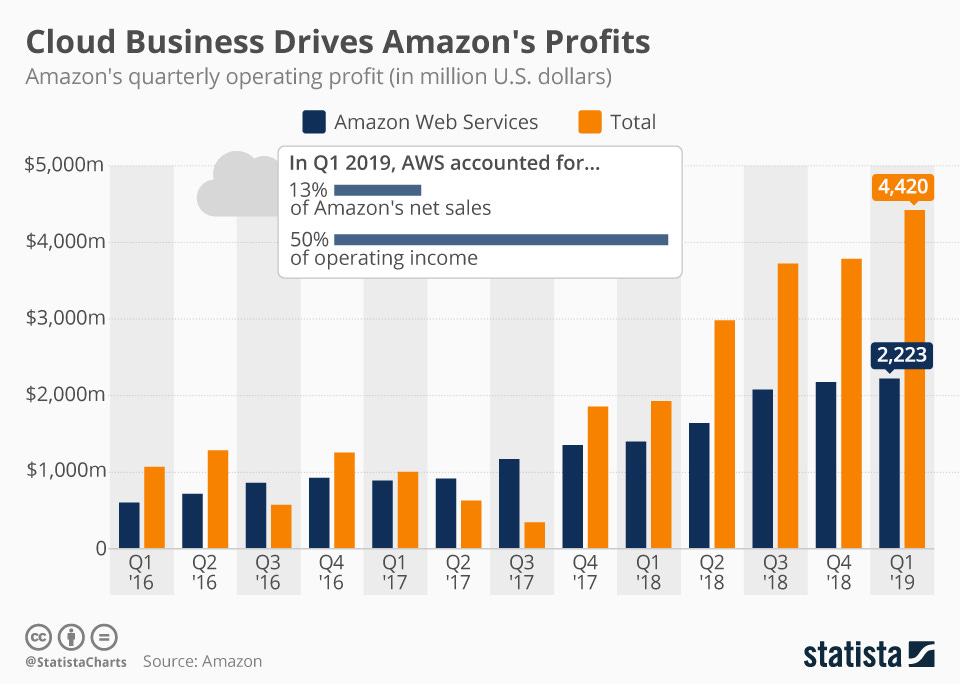
Amazon transformed what every company treated as a cost center in the early 2000s (IT departments) into their most profitable business unit by being the first to refine their process.
Your Workflow is Tomorrow's Standard
You probably don't think you're building the next AWS. But you're wrong.
Every day, you’re wrestling with problems that make you uncomfortable. Creating makeshift solutions. Cobbling together workflows that feel messy and unpolished.
These aren’t band-aids. They’re early prototypes of tomorrow’s operating procedures.
Amazon's cloud infrastructure started as an internal necessity. Your next opportunity is probably sitting in your current workflow, disguised as "just how you get things done."
"But what if I'm wrong? What if I waste time on something that never matters?"
The real question is: "What's the cost of being wrong versus the cost of being late?"
When something is pre-consensus:
Inputs are cheap (time, attention, resources)
Competition is minimal
You can develop proprietary processes
You learn by doing, not by copying
When something is post-consensus:
Inputs are expensive (everyone wants in)
Competition is saturated
Best practices are documented (your advantage is gone)
You learn by following, not creating
This isn't about betting your career on predictions. It's about building adaptive capabilties while costs are low.
Build Systems Before Consensus
Here's how to systematically position pre-consensus:
1) Build systems, not just solutions
Don't just solve the immediate problem. Build repeatable, scalable processes
Document everything.
Create frameworks others can use.
2) Perfect in private, deploy when consensus forms
Develop your processes before anyone cares.
When others start learning basics, you're already teaching advanced concepts.
3) Recognize when your "supporting work" becomes your main value
Watch for the moment when people start asking "How did you do that?" about things you consider basic workflow.
Don’t Follow The Playbook
Most people think linearly about opportunity:
See trend → learn best practices → implement proven strategies
But the real leverage is circular:
Face requirements → build processes → perfect systems → become the best practice others copy
When you position pre-consensus, you're not gambling on predictions. You're experimenting to find the optimal process.
You're developing expertise while costs are low. You're creating processes that compound over time. You're building systems that become industry standards.
Society splits into two groups: Those who wait for proven playbooks and those who build the playbooks.
Here’s the thing: proven techniques don’t provide an edge. The playbooks only get open-sourced when volume is more valuable than effectiveness.
Shift how you see every emerging area.
Stop waiting for certainty. Start building in uncertainty.
You'll develop processes while others develop opinions.
And over time... you'll wonder why you ever waited for someone else's playbook once you have the conviction to trust your judgment (even when it's different from the crowd).